Author: Tim Levin

  • The Facts Are In: It’s Not Looking Good For Internal Combustion

    The Facts Are In: It’s Not Looking Good For Internal Combustion

    The “EV slowdown” is overblown. It’s internal-combustion cars that are on their way out.

    [Published June 2024 on InsideEVs. For a more interactive data experience, check this story out there.]

    The last several months have been messy for the electric vehicle industry, to put it mildly. 

    Major players like General Motors, Ford and Mercedes-Benz are pumping the brakes on their electrification efforts, citing uneven and unpredictable consumer demand. Many drivers remain hesitant to go electric because they’re worried about a lack of charging stations and insufficient range. 

    Tesla, the longtime leader in the space, could’ve led the charge this year with new and updated models but is focusing on AI and robotics instead. After years of meteoric growth, the EV powerhouse reported an 8.5% slump in vehicle deliveries in the first quarter of this year. Lately, the conversation around the electric car market has been defined by bad vibes and a murky outlook. 

    However, when you look past the gloomy headlines and take a broader view, a clear trend emerges: The internal combustion engine is dying out. 
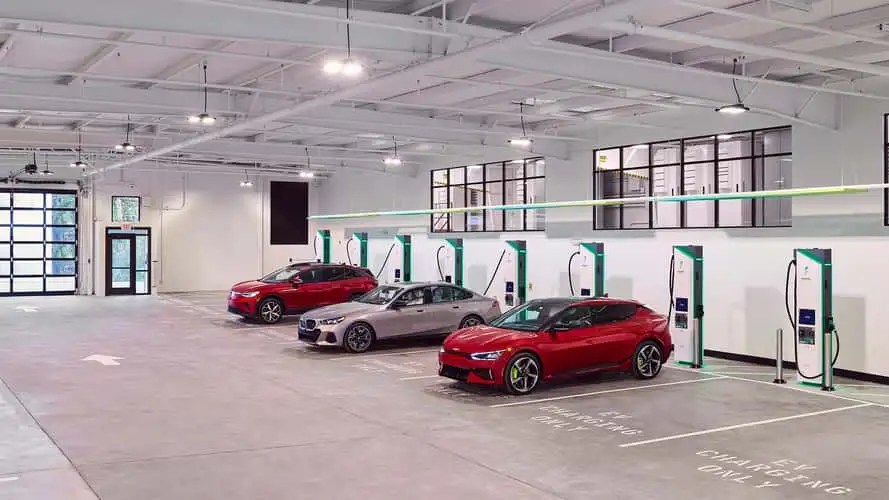

    Electric and hybrid vehicles are gradually—and in some parts of the world, rapidly—edging out sales of conventional, non-electrified gas-guzzlers. Experts say that’s a big win for the planet. And even if some automakers are now announcing new and updated engines to stay competitive if full EV adoption takes longer than expected, it’s hard to dispute the trends that point to the end of the gas-burning era.

    “The market is just looking way too short-term at all of this,” said Daan Walter, principal at RMI, a nonprofit research organization focused on clean energy. “It’s really over for the combustion engine.”

    Charting The Decline Of Internal Combustion

    Sales of internal combustion engine (ICE) vehicles peaked globally in 2017 and have been in decline ever since, according to the research firm BloombergNEF’s (BNEF) latest Electric Vehicle Outlook report. The total fleet of ICE vehicles, including hybrids, on the world’s roads will peak in 2025. By 2027, oil demand for road transportation will also peak, BNEF projects.

    By that year, plug-in (and even hydrogen-fueled) vehicles across segments will help displace 4 million barrels of oil each day, according to the report. That’s roughly the annual oil consumption of Japan. 

    As sales of old-school cars and trucks have fallen, EV sales have skyrocketed. In 2023, some 14 million electric and plug-in hybrid vehicles were sold globally, amounting to 18% of total passenger vehicle sales, according to the International Energy Agency (IEA). That’s a gain of 3.5 million, or 35%, over 2022. Take a longer view and the numbers get even more eye-popping. As recently as 2016, roughly 700,000 plug-in cars were sold worldwide, according to the IEA. Put simply, annual electrified vehicle sales have exploded by 2,000% in well under a decade. 

    The EV transition is here, but it’s far from evenly distributed. China and some Nordic countries are eating much of the world’s lunch when it comes to the uptake of EVs. Still, U.S. sales of ICE vehicles have trended downward as well.

    According to the U.S. Energy Information Administration, the market share of conventional gas-powered cars sank to its lowest point ever in 2023: 84%. Meanwhile, hybrid, plug-in hybrid and fully electric vehicle sales grew to an all-time high of 16% of the U.S. market. Pure EVs, or battery-electric vehicles (BEVs), accounted for a record 7.6% of new vehicle sales last year. 
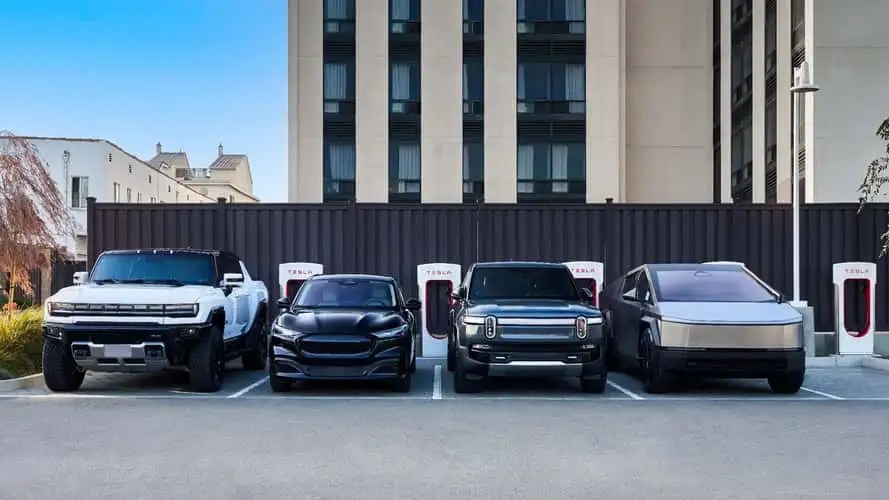
    The U.S. lags far behind China, where aggressive industrial policies and intense competition have catapulted EVs to 50% market share in relatively short order. Regardless, things are moving in the direction of more electrification here too. 

    The EV Market Will Keep Growing, Despite Hiccups

    Despite what you may have heard, EV momentum did not fall off a cliff in 2023; it merely slowed to a pace below previous levels of spectacular growth. Yearly sales of plug-in cars are projected to more than double over the next four years, reaching 30.2 million in 2027, according to BNEF. Sure, the 21% average annual rate of growth worldwide over that period won’t be quite as fierce as the 61% witnessed over the last four years. But is this doomsday for electric cars? It sure doesn’t look like it. 

    EV sales will keep climbing over the long term, giving ICE vehicles no viable path back to 2017 levels. According to BNEF, sales of plug-in cars will hit 42 million in 2030 (45% of sales) and 73 million in 2040 (73% of sales). And that’s assuming no new policy interventions. 

    Government policy—in the form of both carrots and sticks—has been crucial for driving the EV transition thus far and will continue to play a large role in some parts of the world, experts say. But other key tailwinds are coming into play besides generous subsidies or looming ICE vehicle bans. 

    One big one: The economics of both making and buying EVs have gotten better and better as the industry has scaled up. Case in point: The new BYD Seagull hatchback, from China’s biggest EV maker, sells for as little as $10,000 in its home country. As EVs fueled unprecedented demand growth, lithium-ion battery pack costs have plummeted from some $1,400 per kilowatt-hour in 2010 to $139 in 2023, according to BNEF, which says costs should fall further.
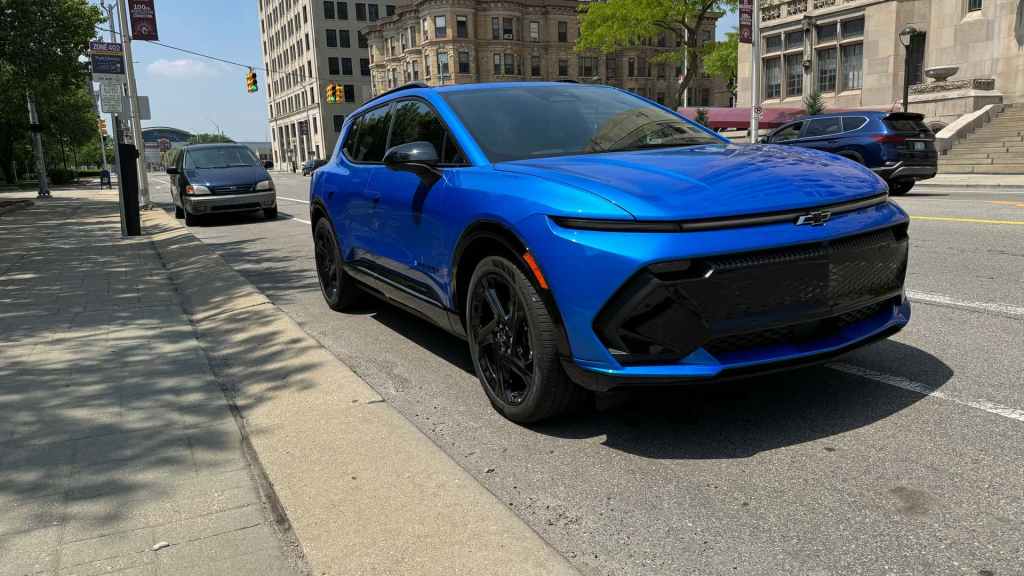
    Continued gains in EV affordability will be key for getting more buyers on board worldwide. EVs have historically skewed toward the luxury end of the spectrum in the U.S., though prices have trended downward. And some models already cost less than gas-fueled counterparts when you factor in the total cost of ownership. That’s because electric cars require less maintenance and electricity generally costs less than gas. 

    The next “inflection point” will be widespread price parity in upfront cost, Walter said. That milestone, when a buyer can understand that an EV will save them money without thinking too hard, has been achieved in some leading markets but not yet in the U.S. “That is really when you see the market go into overdrive,” Walter said.

    What’s more, studies show that once someone buys an electric car they rarely switch back to gas. EV drivers love the savings; the ease of charging at home; and the quietness and smoothness of the ride.

    Another emerging driver of change: competition and the fear of falling behind. Unlike the early, policy-driven days of the EV transition, automakers themselves are aggressively moving the ball forward to stay competitive, said Corey Cantor, a senior EV analyst at BNEF. For car companies, the cost of inaction is higher than ever. 

    “The further we get into this decade, the more the winners and losers will probably differentiate themselves,” Cantor said. “So if you’re an automaker, you can’t afford to not have a BEV strategy from this point.”

    So What About That EV Slowdown?

    To be sure, it isn’t all sunshine and rainbows in EV land. The long-term global picture looks rosy, largely because of China’s ferocious pace of growth. But individual markets, including the U.S., are hitting near-term speedbumps. 

    In the first quarter of this year, U.S. plug-in car sales grew only 4% year-on-year, according to BNEF. That’s mostly a Tesla problem that could stem from its aging vehicle lineup, caustic chief executive, or both. Companies like Ford and GM have actually seen tremendous year-over-year gains on the EV front, despite their bellyaching.

    The Hyundai Motor Group umbrella, which encompasses the Kia and Genesis brands, is also seeing immense success. Any of those three automakers could see 100,000 U.S. EV sales in a year, a milestone only Tesla has achieved here so far.
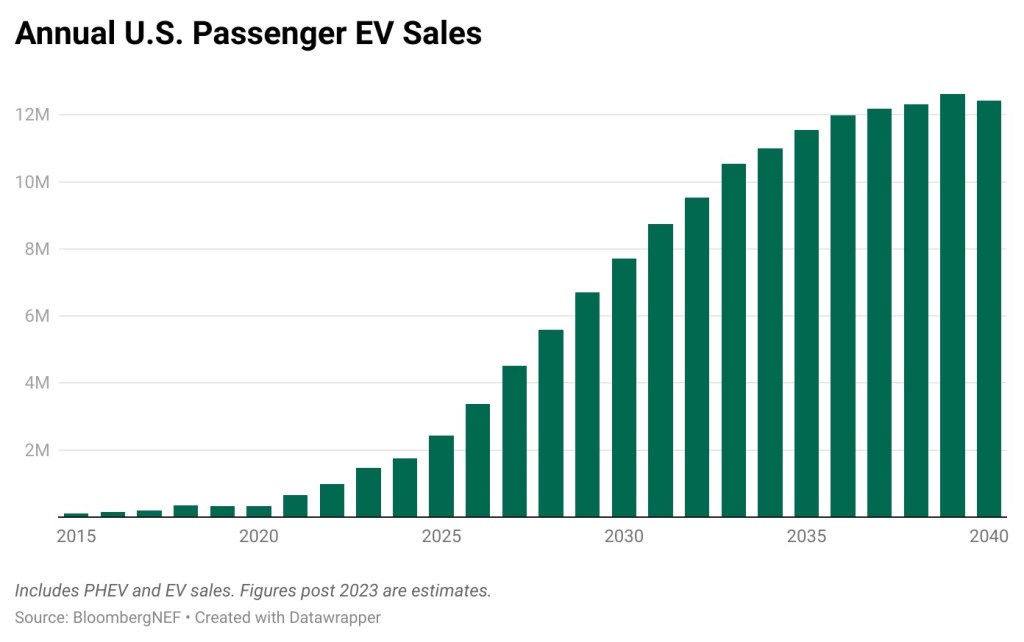
    Plug-in car sales in the U.S. will end the year up 20% over 2023, BNEF says, less than the 32% it had previously projected. Still, it expects plug-in cars to make up 29% of the U.S. vehicle market by 2027. Looking out a few years, the health of America’s EV transition hinges on whether cheaper models materialize in a meaningful way, said Cantor. Think a range of different models in the $25,000-$32,000 range, after incentives. Those kinds of vehicles are in the works from FordGMJeepKia and others. 

    It’s normal for a new technology to see explosive adoption at first, followed by a slower rate of growth. It’s easier to increase sales by 60% or 70% when last year’s sales were relatively small. And it’s harder to sell mainstream buyers on novel tech once the early adopters have run out. 

    Still, climate experts are urging policymakers to do more on EVs. As the effects of climate change become more palpable than ever, the world is still spewing record levels of carbon emissions. And in the U.S., the transportation sector’s CO2 emissions are rapidly bouncing back from their pandemic-induced lows. Most climate scientists believe humanity is headed for disaster if these trends aren’t reversed soon.

    “EV’s are yet another classic technology revolution,” said RMI’s Walter. “The difference now with climate tech is that it’s a technology revolution—but with a deadline.”
  • Yes, Electric Vehicles Are Greener Than Gas Cars — Even When They Use Dirty Power

    Yes, Electric Vehicles Are Greener Than Gas Cars — Even When They Use Dirty Power

    [Published December 2022 on Business Insider]

    Conservative pundits and other skeptics love to claim that electric cars are just as bad for the planet as regular old combustion engines, if not worse. Teslas fill up on electricity generated by dirty power plants, so the argument goes, and mining the materials for their batteries takes a harmful toll on the environment. 

    But the science tells a different story. 

    Studies comparing lifetime emissions of electric and gas-powered cars — from manufacturing through disposal — show that, by and large, driving a battery-powered vehicle is a massive win for the environment. That conclusion holds even when you consider that most electricity in the US currently comes from carbon-producing coal and natural gas and that making an EV isn’t exactly a green process. 

    Building an EV isn’t great for the planet

    Lithium-ion batteries are central to EVs and to the auto industry’s broader electric reinvention. But mining the necessary cobalt, refining the lithium, and packaging it all into little cells that fit neatly in a larger pack creates significant greenhouse gas emissions. 

    That means, perhaps counterintuitively, that “clean” cars begin life with a heftier carbon footprint than their “dirty” counterparts. A medium-sized electric car leaves the factory responsible for 33%-57% greater emissions than a comparable internal combustion engine (ICE) one, the International Energy Agency says

    But since EVs are cleaner to operate than ICE vehicles, they repay that environmental debt relatively quickly once they hit the road.

    (Battery manufacturing, particularly mining, can have other damaging environmental impacts, but we’re sticking to greenhouse gases here. Transportation creates 27% of the country’s climate-changing emissions, and cars and trucks account for most of that.)

    EVs are still cleaner overall

    The Union of Concerned Scientists (UCS) determined how much pollution an electric car with average efficiency and a 300-mile range would generate over its lifetime if it charged using the 2020 US electrical grid, which was far from 100% renewable. The group found that trading in a conventional, 32-mpg sedan for an electric one would slash a driver’s greenhouse gas emissions by 52%. 

    “While there are emissions from making and using electric vehicles, when you take into account all the factors they are much, much cleaner than a gasoline vehicle,” David Reichmuth, a senior engineer at the UCS, told Insider. “They’re not perfect. They’re just much, much better.”

    The International Council on Clean Transportation (ICCT) estimates that a medium-sized EV registered in the US in 2021 will pollute 60-68% less over its life than a comparable model burning fossil fuels. Its analysis assumed that EVs will use increasingly clean electricity over time. 

    The wide gap in emissions is in part a matter of vehicle efficiency; EVs are inherently better at converting energy into motion with minimal losses along the way. While a combustion engine loses a whopping 70% of the energy you feed it to heat, electric motors exhibit 90% energy efficiency, Georg Bieker, a researcher at the ICCT, told Insider. 

    So how long does it take for an EV to shed the baggage of manufacturing and become cleaner than an ICE vehicle? Not all that long, actually.

    The UCS puts the tipping point at 21,300 miles (for the aforementioned electric car and sedan), less than two years of driving for the typical American. A recent Ford-funded University of Michigan study drew a similar conclusion: 1.4–1.5 years for sedans, 1.6 years for pickup trucks, and 1.6–1.9 years for SUVs. 

    Where your energy comes from matters

    Although non-renewable energy sources (excluding nuclear) account for 60.9% of the US’s electricity generation, most Americans are in good shape to benefit the environment by going electric. 

    Per the UCS, more than 90% of the US population lives in an area where driving the average EV produces lower emissions than a 59-mpg ICE vehicle, the most fuel-efficient one available. Based on where electric cars have been sold historically, the average EV on US roads today pollutes roughly as much as a theoretical 91-mpg gas car, the organization estimates.

    But zooming in on specific regions reveals how vastly EV emissions vary across the country. In upstate New York, where three-quarters of power comes from nuclear or renewable sources, the only way to match an average EV’s emissions would be to buy a 247-mpg ICE vehicle. In parts of Hawaii that rely heavily on oil, the magic number is 37 mpg. 

    EVs will get a lot cleaner over time. ICE cars won’t.

    Crucially, EVs’ environmental impact will shrink over time as renewables like solar and wind claim a growing share of the country’s electricity use. And this trend is already well underway. 

    Electric cars that hit American roads in 2030 could have a 76% greener lifespan than gas counterparts if the US builds an electrical grid in line with the Paris Agreement’s goals, according to the ICCT. The UCS reckons that in a future America powered by 95% renewable energy sources, an EV will pollute as much as an ICE vehicle rated at an astronomical 500 mpg. That is to say, very little. 

    “As we clean up the grid, that’s going to make these vehicles have even lower emissions as they’re driven over the next 10, 15, or 20 years,” Reichmuth said. “I think that’s the really important part.”

  • The Incredible, Earth-Saving E-Bike Is Having A Moment

    The Incredible, Earth-Saving E-Bike Is Having A Moment

    [Published in April, 2023 on Business Insider]

    The clean-transportation revolution won’t arrive by way of futuristic hyperloops, driverless taxi pods, or drones the size of minivans — not anytime soon, at least.

    And while electric cars get all the hype, a game-changing solution to getting around without warming the planet has flourished right under our noses. 

    Electric bicycles of all shapes and sizes have whirred and zipped their way into the mainstream in recent years as the pandemic has supercharged an e-biking boom that was already well underway. And that’s a great thing, because although replacing gas-burning cars with electric ones is key to heading off global warming, research has found Americans also need to drive less altogether to avoid climate catastrophe.

    The Earth-saving potential of e-bikes

    Transportation is the single biggest contributor to US greenhouse-gas emissions. And light-duty vehicles (cars, pickup trucks, and SUVs, not semis and airplanes) make up the largest chunk of that. Gains in vehicle efficiency are being dragged down by rising sales of large SUVs and trucks, while practically no progress has been made in reducing the number of miles people drive, Carter Rubin, a transportation lead at the Natural Resources Defense Council, told Insider. 

    All of that makes enticing people to step out of the driver’s seat and onto a bike, bus, or sidewalk increasingly important for meeting climate goals.

    “Cleaner cars are an important solution, but we can’t just focus on cars,” Katherine García, the director of the Clean Transportation for All Campaign at the Sierra Club, told Insider. “We need to make sure we are putting programs in place that really encourage people to take alternatives.”

    E-bikes have loads of potential to pry Americans away from their beloved automobiles, advocates told Insider, especially since short trips could easily be made on two wheels instead of four. According to the US Bureau of Transportation Statistics, more than half of all trips in the US are under 3 miles.

    University of Oxford study found that swapping a car for a bike just once a day slashed an individual’s transportation emissions by a whopping 67%. Another study found that choosing an e-bike for 15% of one’s miles traveled could cut their transportation-related emissions by 12%.

    Fast, fun, and convenient, e-bikes are already helping people make that kind of shift in their daily lives. 

    Victor Silva, a product manager in the suburbs of Washington, DC, bought a RadRunner Plus from Rad Power Bikes for $1,900 in the summer after realizing most of his car trips were only a few miles. Now he’s hooked. He recently bought another e-bike and is looking to sell his and his wife’s second car since it barely gets any use. He said he wasn’t going to miss the insurance payments or traffic jams.  

    “I’m trading an activity that I absolutely hate doing, which is getting stuck in traffic, with something that I actually like doing, which is getting some exercise and riding my bike,” he told Insider. 

    After Wesley Cook and his wife sold their second car last year, they test-rode a pair of e-bikes from a local, Atlanta-based company called Edison Bicycles and never looked back. While they had never biked much before, they’ve slowly replaced daily errands like getting groceries or taking their son to school with e-bike rides.

    Cook, a software engineer, just made an addition to the couple’s fleet — a cargo bike from Urban Arrow that has plenty of room for their son and their baby who’s arriving later this year.

    The e-bike advantage

    The power of e-bikes to alter peoples’ habits and help save the planet is simple and maybe a little obvious. But it’s important and worth spelling out nonetheless: By making biking easier, e-bikes encourage people to ride more. 

    A little electrical assistance goes a long way toward helping people overcome the obstacles keeping them from biking, whether that’s steep hills, a lengthy commute, physical limitations, or the mortifying thought of showing up somewhere with pit stains, John MacArthur, a professor at Portland State University who researches sustainable transportation, told Insider.

    “A lot of those barriers can be broken down by putting a motor on a bike,” he said.

    National surveys he’s conducted have indicated that e-bikes motivate people to ride farther and more often — plus they broaden interest in cycling beyond the stereotypical spandex-clad white man.

    Lyft, which operates bike-sharing systems across the US, has noticed similar trends. It’s seen ridership boom by more than 50% since 2020 and attributes much of that growth to e-bikes. In 2021, e-bikes made up just 20% of Lyft’s New York City fleet but 40% of total rides and nearly two-thirds of journeys between boroughs, which typically involve a steep climb over a bridge. 

    As many people who have ridden an e-bike will tell you, they’re just plain fun — and they can often get you places faster and with less hassle than a car or bus. They’re that rare thing in life that’s both good and good for you.

    “They’re kind of a rocket fuel for regular biking,” Rubin, a daily e-biker, told Insider. 

    Electric cars are important, too, but they’re expensive and far off for a lot of drivers, MacArthur said. Just consider someone who recently bought a gas car and doesn’t plan on trading it in for a decade. E-bikes, on the other hand, are an option that’s right here, right now. 

    The most popular electric vehicles in the US don’t have a Tesla logo

    While electric cars get all the attention, e-bikes have for years been the best-selling electric vehicles in the US.

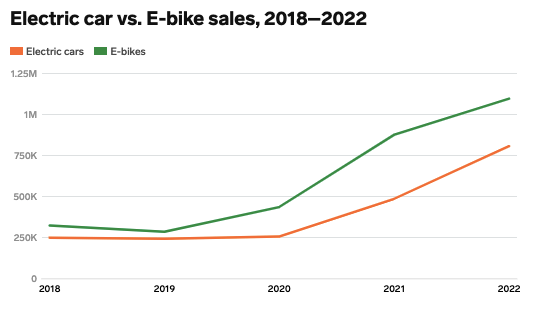
    Last year, Americans bought just over 800,000 electric cars, according to Kelley Blue Book, a record. E-bike imports (a good proxy for sales since most e-bikes aren’t made in the US) numbered around 1.1 million, surging from 880,000 in 2021 and 437,000 the year before, according to an e-bike-industry trade group. 

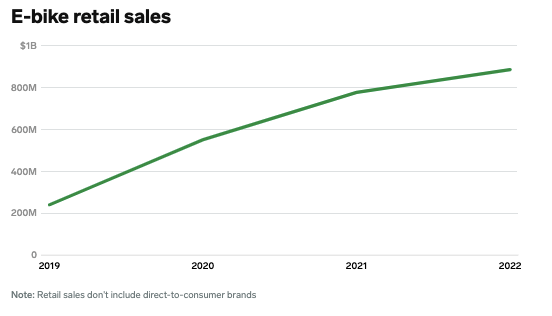
    In dollar terms, e-bike retail sales nearly quadrupled in the past four years, rising from $240.1 million in 2019 to $885.5 million in 2022, the market-research firm Circana estimates. While sales of leg-powered bicycles slumped 16% last year, e-bike sales jumped by $100 million.

    Ed Benjamin, the Light Electric Vehicle Association’s chair, chalks up the trend to growing awareness among consumers and more interest and know-how among bike sellers. The pandemic, which made people wary of close-quarters public transit, boosted e-bike fandom to new heights, he said. And sales show no sign of slowing down. In China and some parts of Europe, one out of every two bikes sold has a motor, Benjamin said, which indicates there’s plenty of room for growth in the US. 

    Improving tech and new form factors for different types of shoppers have fueled public appetite, too, MacArthur of Portland State said. Now buyers can choose from a wide variety of regular-looking bikes, folding bikes, tricycles, fat-tire mopeds, and even cargo bikes, which have extra room for groceries and seats for children.

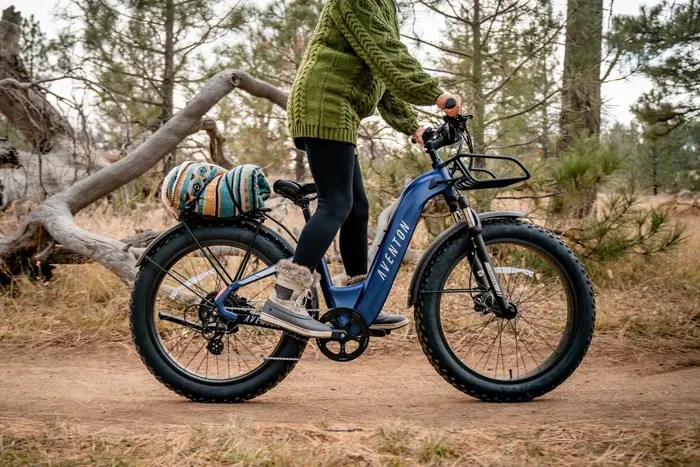
    The demand explosion has meant boom times for e-bike makers who played their cards right, like California’s Aventon, which got its start in 2013 selling (nonelectric) fixed-gear bikes.

    Seeing the potential in e-bikes, the young firm went all in on the technology in 2020, at what turned out to be a very opportune time. Since then, it’s expanded its lineup to seven models and multiplied its revenues by a factor of 42, Aventon’s chief marketing officer, Adele Nasr, told Insider. One key driver of the success, Nasr said: Customers are increasingly seeing e-bikes as legitimate tools for replacing car trips, rather than just toys for recreation.

    “They’re starting to think about them differently, starting to imagine use cases that are so much more evolved than they were even three years ago, which is incredible,” Nasr said. 

    Congress could give the e-bike boom another jolt

    While the federal government has committed billions of dollars to public EV charging and $7,500 tax refunds to buyers of Teslas and electric Ford F-150s, it’s largely left e-bikes out in the cold.

    That’s a big mistake, said Noa Banayan, the director of federal affairs at PeopleForBikes, an advocacy group that represents the bike industry. Since e-bikes are much cheaper than electric cars, “you can get them into the hands of consumers faster,” she said.

    But times are changing. In March, a group of congresspeople reintroduced the Electric Bicycle Incentive Kickstart for the Environment (E-BIKE) Act, which proposes a 30% discount (up to $1,500) for the purchase of a new e-bike. The law could not only make e-bikes more accessible to more Americans, Rubin, of the Natural Resources Defense Council said, but also send a powerful message to state and local governments to get serious about safer cycling infrastructure such as protected bike lanes.

    Unlike when it was first introduced (then scrapped) in 2021, the bill now has support from major environmental groups, including the Sierra Club and Environment America.

    “Now they’re realizing that electric bicycles and active transportation, and micromobility more broadly, should be a part of their larger transportation and climate agendas,” Banayan said. “That’s really exciting.”

  • Electric Cars Won’t Overload The Power Grid — And They Could Even Help Modernize Our Aging Infrastructure

    Electric Cars Won’t Overload The Power Grid — And They Could Even Help Modernize Our Aging Infrastructure

    [Published October 2022 on Business Insider]

    Battery-powered Teslas, Fords, and Volkswagens aren’t about to overwhelm the US electrical grid, despite what Tucker Carlson and some Republican politicians say.

    Last month, electric-vehicle skeptics had a field day after California’s utility urged customers to conserve power during a scorching heat wave by limiting when they charge their cars. Some conservatives questioned how the state expected to ban sales of combustion-engine cars by 2035 if it couldn’t handle the EVs on its roads today. 

    On his Fox News show, Carlson bashed electric cars as a “new way to overburden California’s already collapsing energy grid.” 

    Energy and transportation experts disagree. 

    More electric cars plugging in will increase energy demands over time, necessitating a more robust grid and smarter charging habits, they say. But there’s no cause for immediate alarm. With some careful planning, there will be plenty of electricity to go around. 

    Someday, EVs may even make the grid stronger and more resilient. 

    EVs aren’t a big power suck

    Even in California, which has far more electric cars than any other state, EVs make up just .4% of all energy consumption during peak hours. By 2030, some 5.6 million electric cars, trucks, and vans would still only comprise 4% of electricity demand during those same hours, according to estimates from California’s Energy Commission. 

    “Saying they’re what’s straining the grid ignores 99.6% of today’s challenge,” Max Baumhefner, a senior attorney with the Natural Resources Defense Council, said in a recent blog post.

    Moreover, while the pace of EV sales is accelerating, it’s going to be a long time before electric cars make up most of the US fleet. Americans keep their cars for 12 years on average, so it’s not as if the country’s appetite for electricity will spike overnight. 

    The clean-energy think tank RMI projects that total US electricity demand will grow 1% to 2% annually as a result of electric-car adoption. That’s comparable to the increases utilities contended with during the 20th century’s energy-consumption booms, which occurred during the proliferation of refrigeration and air conditioning, the group said.

    “Load growth is something that some utilities haven’t had to deal with for a while, but it’s generally well within the range of what utilities can plan and manage for,” Chaz Teplin, a principal at RMI, said, adding that the greater challenge will be transitioning the country to renewable energy sources. 

    Still, the extra load will necessitate substantial grid upgrades over time, experts say. According to a 2020 study from the Brattle Group, 20 million light-duty EVs on US roads by 2030 will require spending $45 to $75 billion on more robust systems of energy generation, distribution, and storage. 

    EVs are uniquely flexible

    Unlike a refrigerator that needs to keep food cold 24/7 or an air conditioner that might draw power for hours on end on a hot day, a typical electric car might be parked 23 hours out of the day. That affords lots of flexibility in terms of when they’re charged. 

    Shifting charging to times that are easiest on the grid — like overnight when demand is low or during the day when solar farms are generating the most electricity — can do wonders for reducing grid stress as more EVs hit the road, experts said.

    “For the foreseeable future, we can do a lot with the grid we already have,” Nick Nigro, the founder of Atlas Public Policy, a transportation-focused consultancy, told Insider. 

    RMI sees California’s recent heat wave as real-world proof that this more clever approach to charging works: People adjusted their habits slightly, and the state avoided blackouts. 

    If drivers continue to charge whenever they feel like it, “then it means we need to build an extremely robust grid,” Matthias Preindl, an electrical engineering professor at Columbia University, said. But smart-grid technology that instructs vehicles when to charge could eliminate the need for infrastructure upgrades in many areas, he said. Some utilities have smart-charging programs, but they aren’t commonplace yet. 

    recent study of the 2035 EV ecosystem found that simply encouraging people to plug in their cars during the day could save Western states billions on energy-storage investments. The logic goes like this: As the US gets more and more of its energy from solar power, it will need vast amounts of batteries to store electricity for nighttime use, when the sun isn’t shining. Widespread daytime charging could cut down on that need. 

    In the future, EVs can support the grid

    Some experts envision a future where EVs can augment power grids — if used cleverly. Vehicle-to-grid technology, or V2G, would transform plugged-in electric cars into a distributed battery system that utilities could tap into during emergencies or other times of excessive demand. During a future heat wave, for instance, utilities could draw a little bit of power from thousands of EVs to keep air conditioners and hospitals humming along. 

    While that’s not exactly happening tomorrow, car companies are already dabbling in similar technologies that work on a smaller scale. Ford’s F-150 Lightning pickup truck can double as a backup generator and power a home for up to three days, for example.

    Preindl said V2G will be crucial for weaning the US off of fossil fuels, by helping to store electricity generated by wind and solar, which are cleaner but more intermittent energy sources. “If all cars are electric, the amount of energy storage we have access to is huge,” he said.

  • Rivian CEO Sounds Alarm On Trump’s Tariffs: ‘Inflation Could Be Damaging’

    Rivian CEO Sounds Alarm On Trump’s Tariffs: ‘Inflation Could Be Damaging’

    R.J. Scaringe said tariffs on Mexico and Canada could have a bigger impact than the end of the EV tax credit.

    [Published on InsideEVs Jan. 30, 2025]

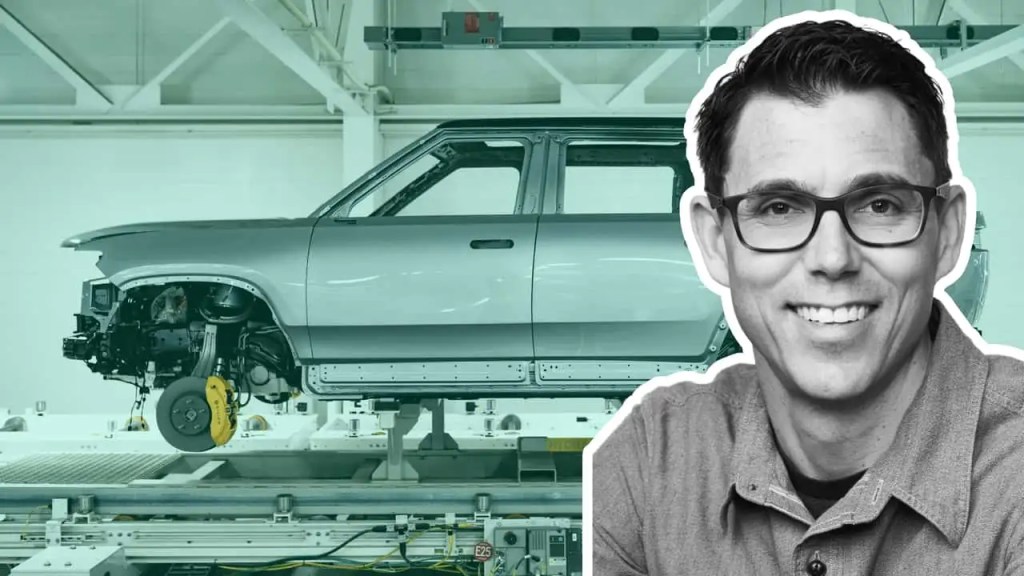
    Forget the EV tax credit. Rivian founder and CEO R.J. Scaringe is far more concerned about another threat from President Donald Trump: tariffs. 

    “It has, in some ways, bigger implications, far bigger, than what happens with the IRA tax credits,” Scaringe told reporters last week, referring to the 2022 Inflation Reduction Act, which contains pro-EV policies that Trump has attacked time and time again.

    “There’s not a car company in the world that’s not thinking about moving supply chains around right now,” Scaringe said.

    Trump plans to slap 25% tariffs on imports from Mexico and Canada on February 1, in an attempt to pressure those governments into preventing the flow of drugs and undocumented immigrants into the U.S. But it’s American consumers and companies operating here that will pay the price as higher duties jack up prices for finished goods and their component parts. 

    “The inflation environment that that’s going to create is, just from an economic standpoint, we believe could be really damaging,” Scaringe said of the blanket tariffs Trump has proposed. 

    The outlook is particularly nightmarish for America’s auto industry, which has for decades relied heavily on Mexico and Canada to build car parts and entire vehicles. Under the U.S.-Mexico-Canada agreement (and the North American Free Trade Agreement before that), there are no tariffs on most goods passing between the three countries. 

    “It’s not as if it’s like one supplier,” Scaringe said. “Many, many, many hundreds of billions of dollars have been invested in Mexico in production capacity for supply chains that supply to all of us. That will need to get remapped or will just carry higher costs.”

    Scaringe said Rivian is fortunate in that much of the content in its vehicles is built in the U.S. The factory where the California-based startup makes its three EVs—the R1S SUV, R1T pickup and EDV commercial van—is in Illinois. A second plant is planned in Georgia. Still, he said the ripple effects of higher costs will be felt throughout the automotive supply chain. 

    Rivian is far from alone. This should put the scale of the issue into context: The research firm S&P Global Mobility estimates that 3.6 million light-duty vehicles sold in the U.S. in 2024 were built in either Canada or Mexico. That’s about 22% of all the new cars sold in America last year. 

    In a recent report, the firm said “virtually all” automakers and suppliers would feel the heat of Trump’s proposed tariffs. According to S&P Global, 23% of Jeep-parent Stellantis’ U.S. sales were sourced from Mexico. For General Motors, it was 22%. Nissan gets 27% of its U.S. sales from Mexico, and Volkswagen is “most exposed to tariff risk,” the report said, with more than 43% of its U.S. sales sourced from the country. 

    A Nissan spokesperson said the company “cannot speculate on potential policy changes or their impact.” A spokesperson for the Volkswagen Group emphasized the company’s growing investments in U.S. manufacturing. Volkswagen remains “a strong advocate for free and fair trade” and “looks forward to continuing its longstanding and constructive partnership with the U.S. administration,” they said.

    Stellantis declined to comment. Several other automakers didn’t return a request for comment. 

    On top of that, it’s extremely common for cars assembled in the U.S. to get components—like wiring harnesses or entire engines—from those countries. Some parts cross the northern or southern border several times before making their way into a vehicle. 

    Electric cars are already, by and large, more expensive than their gas counterparts. (Rivians, for example, start at $70,000.) And the tariffs won’t help matters. The Chevrolet Equinox EV and Blazer EV are both made in Mexico, along with the Ford Mustang Mach-E. All Teslas get at least 20% of their content from Mexico, according to government filings. 

    But there’s a reason some U.S.-made EVs may be slightly more insulated from the tariffs than combustion vehicles, said Mike Wall, executive director of automotive analysis at S&P Global. To save on logistics costs, automakers often make their battery packs—the most expensive single part of an EV—near where the vehicle undergoes final assembly. Contrast that with combustion vehicles, which he said often get big, expensive parts like engines from outside the U.S.

    “Now, those downstream components into that battery pack could be coming from a number of places, including Canada and Mexico, but that finished assembly is going to be, more likely than not, reasonably close by,” Wall said. 

    The big question going forward, Wall says, is what exactly these tariffs look like when all is said and done. The final measures could target specific goods, and that would alter their impact on the auto industry, he said. 

    Scaringe said Rivian is keeping a close eye on the tariff situation.

    “I think today it’s hard to predict exactly how that’s going to go,” he said.

  • Elon Musk’s Self-Sriving-Car Project Is On A Road To Nowhere

    Elon Musk’s Self-Sriving-Car Project Is On A Road To Nowhere

    [Published on Business Insider Mar. 29 2023]

    Elon Musk has spent much of the last decade assuring and reassuring customers and investors that driverless Teslas are right around the corner. Spoiler alert: You still can’t take a snooze at the wheel or watch Netflix in traffic.

    There was the press conference in 2016 when Musk predicted that Tesla would send a car from Los Angeles to New York City without human input by the following year. Then in 2019, he said he felt “very confident” that, by 2020, Tesla owners who bought the pricey Full Self-Driving option would be able to dispatch their cars as robotaxis and rake in passive income from their couches. 

    “Today it’s financially insane to buy anything other than a Tesla,” Musk said at an event touting the carmaker’s autonomous-vehicle development in 2019. “It’ll be like owning a horse in three years.”

    That revolutionary software update never came, and by 2022 the goalpost for bringing self-driving cars to the masses had shifted to 2023. Meanwhile, Musk has doubled down on the importance of driverless tech, going so far as to say the carmaker will be “worth basically zero” if it can’t crack autonomous driving. Over the years, Tesla has hiked the price of Full Self-Driving to a whopping $15,000.

    While it’s made strides and released an audacious prototype version of Full Self-Driving that owners are testing around the country, Tesla still hasn’t delivered on its core promise of making cars that drive themselves. Some automated driving experts think it won’t happen anytime soon. 

    Full Self-Driving is far from actually being self-driving, some say

    Despite its branding, Tesla’s Full Self-Driving Beta currently requires total driver supervision, just like cruise control or smarter features like Autopilot. Unlike those systems, which work on the highway, Full Self-Driving aims to navigate a Tesla from a starting point to a chosen destination in all environments, from rural roads to chaotic city intersections and everywhere in between. Once software updates improve the system sufficiently, the idea is to convert the driver into a passenger. 

    But according to Phil Koopman, an engineering professor at Carnegie Mellon University who specializes in autonomous vehicles, Full Self-Driving doesn’t look nearly reliable enough to function safely without a driver, given the types of simple mistakes it’s still making. If the system were as close to ready as Musk claims, it would stumble only once in a blue moon and exclusively in freak scenarios that might trip up a human driver, he told Insider. 

    That’s not yet the case. For all the impressive-looking videos shared online of the Beta smoothly traversing intersections and roundabouts, plenty of clips show a jerky system struggling with routine driving tasks like slowing for speed bumps and choosing the correct lane. That’s not to mention numerous recent crashes involving Tesla’s automated systems and stopped emergency vehicles that are under federal investigation

    “Tesla keeps saying next year, and I still don’t see any reason to believe that promise,” Koopman said. “There’s no reason to believe that something magic will happen this year that failed to happen the year before and the year before and the year before.”

    Tesla’s goal to flip a switch and deploy Full Self-Driving everywhere, without limits, is beyond a stretch and won’t happen safely in the near future, Daniel McGehee, director of the University of Iowa’s Driving Safety Research Institute, told Insider. Some companies, like Alphabet’s Waymo and GM’s Cruise, have launched autonomous taxis in the US, but only in specific parts of certain cities. Starting with a confined, predictable environment and expanding from there is the right move, McGehee said. 

    “Automation is going to be incremental and not just ready one day,” he said. 

    Tesla did not return a request for comment. 

    Musk’s big bet on cameras

    Tesla does things differently. That mentality started with its bet on electric vehicles and extends to the very core of its approach to autonomous driving.

    While rivals like Cruise and Waymo use detailed maps and an extensive array of sensors to help their vehicles navigate the world, Musk wants to simplify things. If humans can drive with eyes and a brain, cars should be able to drive themselves using cameras and computing power, Musk argues. 

    Koopman calls that a “completely ridiculous analogy,” given that machine-learning programs just do statistical analysis and can’t truly understand situations like humans can. He thinks Tesla needs to significantly alter its approach to make self-driving happen. 

    “Why would you want to tie one hand behind your back doing something that’s nearly impossible?” Koopman said. 

    Likewise, McGehee says self-driving cars need a combination of overlapping sensors — whether that’s cameras, radar, lidar, or ultrasonic sensors — to move through the world safely. He stresses the importance of redundancy to students in his automated vehicle engineering course. 

    To be sure, others aren’t so quick to write off Tesla’s way of doing things. Alain Kornhauser, director of the program in transportation at Princeton University, supports the vision-only approach and thinks Tesla is well on its way to autonomous operation. But, he says, self-driving anywhere all the time isn’t realistic.

    What do owners think?

    Musk’s ambitious promises and the real-world performance of Full Self-Driving have left some Tesla owners — who paid anywhere from $5,000 to $15,000 for the feature over the years — feeling frustrated and disappointed. 

    Kenji, a 2019 Tesla Model X owner who withheld his last name to avoid online harassment from Tesla fans, said he shelled out for Full Self-Driving after hearing Musk talk up the system’s imminent potential. Years later, the system frequently makes unsettling mistakes, leaving Kenji feeling “duped.” Reporting that Tesla staged an infamous 2016 video touting its autonomous tech added insult to injury, he said. 

    “I almost wish I could get a refund,” he told Insider. “Because it’s not ready, and I don’t think it’s going to be ready for a while.”

    Nick Nicastro, a Tesla Model Y owner in Ohio, called the software “absolutely phenomenal” but said it occasionally botches basic maneuvers, forcing him to intervene. He’s satisfied with the feature, but reckons it may be another decade or more before Tesla drivers can kick back while their cars do the work. 

    “As good as it is, the idea of me not having a steering wheel there is many, many, many years away,” he said.

  • Fisker Is Bankrupt. Owners Are Angry And Scrambling For Answers

    Fisker Is Bankrupt. Owners Are Angry And Scrambling For Answers

    Fisker Ocean owners have no idea what the future holds. Those with broken cars are in panic mode.

    [Published on InsideEVs June 25, 2024]

    Fisker buyers were dazzled by the electric vehicle startup’s sustainability focus, its debut SUV’s dashing looks and the allure of driving something few others even knew existed. Now some likely wish they could turn back the clock and buy literally anything else. 

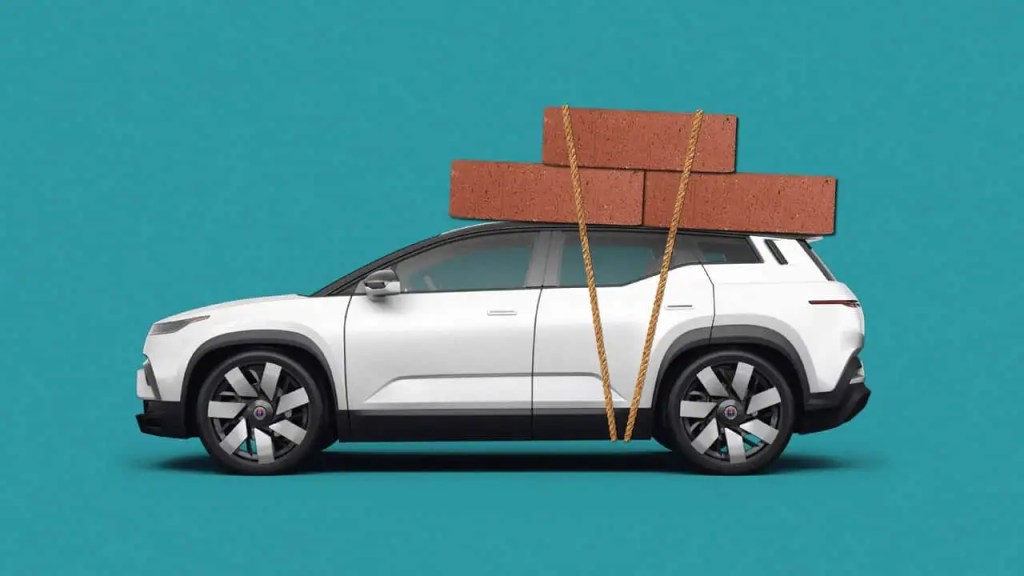
    After months of flailing, Fisker filed for bankruptcy protection last week, leaving customers who plunked down some $70,000 for their Ocean EVs (and are often still on the hook for their loans) feeling frustrated, angry and duped. What may be most unsettling is they have no clue what happens next. 

    “Now we all own cars that were manufactured by a company that has filed for bankruptcy,” Cristian Fleming, an Ocean owner in New York, told InsideEVs. “Nobody really knows what that means.” 

    If Fisker doesn’t rise from the ashes of Chapter 11 restructuring—and some kind of financial lifeline seems increasingly unlikely—will customers be able to get their cars fixed easily over the long run? Will they ever receive the missing features they were assured would be beamed to their cars via future software updates, such as adaptive cruise control or lane-change assist? If something breaks in a month or a year from now, where will replacement parts or bug fixes come from? What about warranty repairs and insurance? Will the 4G connection that enables functions like navigation just go dark one day? 

    That’s just some of what Fisker owners have expressed concern about in recent conversations with InsideEVs and on online forums. 

    Ocean Owners Worry About Parts, Software Updates and Key Fobs

    Plenty of car brands have closed up shop entirely or stopped selling cars in the U.S. Consider Saab, DeLorean, Suzuki, Pontiac or Packard. But Fisker flamed out so quickly that it has put customers in a particularly nasty bind.

    The startup leaves behind both an unfinished car and an underdeveloped support system for it, making the scramble for answers that much more pressing. Had Fisker released a more battle-tested product and created a more robust service operation, it arguably could have avoided this mess altogether.

    Moreover, the Fisker Ocean is very different from any of the “orphaned” cars that came before it. While a Bricklin SV-1’s owner probably doesn’t have the easiest time finding parts, that car still depends purely on mechanical repairs to stay on the road. The Ocean, however, is underpinned by modern connected-car software. If that software or the network behind it aren’t maintained properly, the Ocean could lose key functions—much like how older smartphones are hamstrung by the lack of a 3G network.  

    Plus, software hasn’t ever been the Ocean’s strong suit. In the year since the Ocean went on sale, many owners have grappled with all sorts of software glitches and hardware issues. The National Highway Traffic Safety Administration has opened four investigations into the Ocean, including over a braking malfunction. Fisker recently issued a recall to address a defect that can lead to loss of power. Bankruptcy leaves some owners wondering whether their cars will ever function as advertised. Even if their current issues somehow get resolved by Fisker’s skeleton service department, some worry about more problems popping up. 

    One owner, who asked to remain anonymous for personal reasons, said he finally got a Fisker technician to order him a new infotainment screen, which had been going black occasionally, and door handles, which were brittle and cracking. Now he’s not sure if those parts will ever arrive. And besides, he said, that just scratches the surface of the issues he’s reported to Fisker. 

    “There are so many things I’ve sent in tickets for, I can’t even in my mind remember all of them,” the owner said. “Is all of that just gone?” 

    He said he’s hoping “something magical happens”—that an experienced carmaker takes the reins and finishes the Ocean’s software. Aside from bug fixes, he’d love to finally receive adaptive cruise control, a fairly commonplace feature these days. 

    This year Fisker has laid off most of its workforce, including large numbers of service technicians. In the last few weeks, owners have reported waiting on Fisker’s customer service line for hours only to be disconnected. They say their emails and social media messages have gone unanswered. In its final months before bankruptcy, Fisker began pivoting away from Tesla-like direct-to-consumer sales and toward a conventional dealership model. It’s possible that the handful of dealerships that have sprung up will provide service into the future even if Fisker ceases to operate, but that’s not clear yet.

    Tracking down basic replacement parts was a nightmare even while Fisker was still fully operational. Fisker leadership believed the Ocean would be so well-built that a stockpile of parts in the U.S. wouldn’t be necessary, InsideEVs reported previously. As a result, Ocean owners have waited weeks or months for things like windshields and bumpers. Going forward, some worry that a fender bender or faulty component could render their car undriveable. Customers were also only provided one key fob, which has been prone to issues and ranks at the top of many owners’ lists of gripes.

    “​​I’ll keep driving mine until I can’t anymore…which could be for an idiotic reason like the fob breaks. Or the windshield,” wrote one Redditor. “Super weird when the best case scenario would be having someone else run into the car and it get totaled out.”

    Some owners are in better spirits than others, particularly those whose experiences have been smooth thus far. Andrew Bock, a business owner in Northern California, loves his Ocean and went into the purchase understanding the risks, he told InsideEVs. He hasn’t experienced any major issues, but he is concerned about losing internet-enabled features or his key fob. He hopes Fisker can dole out more keys to owners as part of its bankruptcy. 

    “I’m disappointed, but I’m not, like, ‘the world is falling,’” Bock said, acknowledging that he’s probably in the minority. 

    In general, Ocean owners say they really enjoy the car when it works. But those with broken cars are in panic mode.

    A Broken EV And No Fix In Sight

    Mike Satz, who works in sales support in New Jersey, bought his Ocean prepared for some early hiccups. But he also expected Fisker to be around to iron out those issues as they arose. Instead, he is sitting on a vehicle that won’t turn on and he hasn’t been able to get in touch with Fisker’s customer service, he told InsideEVs. Upon hearing the bankruptcy news, he first felt angry, and then hopeless, he said. 

    “It’s just this whirlwind of emotions,” he said. “Everybody that has a Fisker at this point has to understand that this is a really bad situation to be in.”

    He wonders whether he should sell his car for parts, given the shortage of components. He said he feels let down by the startup, which devalued his car by slashing prices, abruptly canceled roadside assistance and saddled him with a car he is paying for but can’t drive. 

    “All these little things add up to just aggravate and stick it to the customer that actually supported them through all this,” Satz said. 

    Holly Affleck, a business executive in Fort Worth, Texas, told InsideEVs that her Ocean has been stuck in a limp mode, wherein it can’t go faster than about 30 mph, since late March. Fisker told her she needed a new cooling pump but has not been able to provide one or fix her car, she said. She entered into arbitration against Fisker in the hopes of forcing it to buy back her Ocean and won the case in June—just in time for the company to go bankrupt. 

    She doubts Fisker will ever refund her and is resigned to fixing her car any way she can. (Indeed, in a recent budget filed in Delaware bankruptcy court, Fisker did not allot any funds for vehicle buybacks.) But the hunt for parts has been difficult.

    “Without the ability to get parts, we’re all in limbo,” Affleck said. “I am sick that there are not greater consumer protections for likely the second-largest purchase of any American in their life.”

    She and others said Fisker should have been more forthcoming about its financial struggles earlier on. If buyers had better understood what was just around the bend, they could have sold their Oceans when they were worth more or backed out of the purchase altogether, they said. In recent bankruptcy court filings, Fisker described being in financial distress as early as last August, right around the time that it hosted a splashy event previewing three future models.

    Artin Boghouzian, an attorney with CA Lemon Law Firm in California, said he recently sent Fisker demand letters on behalf of 11 Ocean owners who claim their cars are defective. The startup’s legal team hasn’t responded to them in weeks, he said. With Fisker bankrupt, getting any kind of settlement for his clients just got much harder, as they’d have to pay his fees just to wind up in a long line of creditors who are owed hundreds of millions of dollars. He said his clients are “furious, upset, defeated, let down, feeling like they got screwed over because they did.”

    “You’re dealing with people that are stuck. They got screwed. They have no recourse,” Boghouzian said. “They’re sitting with a brick in their garage that they don’t even want to look at anymore.” 

    Normally, automakers are open to resolving Lemon Law claims quickly, he said, whether that means buying back a faulty car or fixing it and compensating the driver for their troubles. 

    Ocean Owners Step Up Where Fisker Failed

    Fisker owners are in the dark right now about what the future holds. The Wall Street Journal reported on Friday that the firm is in talks to sell the some 4,000 remaining unsold Oceans to a leasing company in New York that specializes in Uber and Lyft vehicles. To some owners, that’s a glimmer of hope that they won’t be abandoned entirely.

    But with Fisker on life support and running out of options, Ocean owners are taking charge of their lousy situation as best they can. Some just launched the Fisker Owners Association, which aims to keep Oceans roadworthy as long as possible—even if Fisker itself doesn’t make it. Its members are working to secure a healthy supply of parts, publish do-it-yourself fixes and advocate for the interests of owners during Fisker’s bankruptcy discussions. 

    The group is fighting for their warranties, for the continued availability of parts and 4G connectivity and for ongoing maintenance of the IT infrastructure that technicians connect to when they service Oceans. They want Fisker to deliver all the features they were promised, or at the very least pay owners their value. 

    In the meantime, Fleming, one of the organization’s founders, has a message for Henrik Fisker, Fisker’s namesake and CEO: “Think about the people who bought your cars.”

  • Car Companies Want To Make Billions By Charging Monthly Fees For Features Like Heated Seats

    Car Companies Want To Make Billions By Charging Monthly Fees For Features Like Heated Seats

    [Published on Business Insider Nov. 21, 2022]

    How would you feel about paying $5 each month for the ability to lock and unlock your car from a distance through an app? What about a $25-per-month charge for advanced cruise control or $10 to access heated seats? What if those charges continued long after your car was paid off? 

    As vehicles become increasingly connected to the internet, car companies aim to rake in billions by having customers pay monthly or annual subscriptions to access certain features. Not content with the relatively low-margin business of building and selling cars, automakers are eager to pull down Silicon Valley-style profits.

    But unlike with Netflix, you won’t be able to use your ex-girlfriend’s uncle’s login in your new BMW. And car buyers don’t seem too thrilled about the idea.

    For automakers, the advantage of this model is clear. Not only do they get a stream of recurring revenue for years after an initial purchase, they can hope to maintain a longer-term relationship with the customer and build brand loyalty, said Kristin Kolodge, vice president and head of auto benchmarking and mobility development at J.D. Power. 

    This approach can also allow carmakers to streamline manufacturing by building cars to more uniform specifications, Mark Wakefield, who runs the automotive and industrial practice at the consulting firm AlixPartners, told Insider. Down the line, owners can add on the features they want à la carte. 

    It’s all made possible by the advent of over-the-air software updates, which were pioneered by Tesla around a decade ago and are now entering the mainstream. Today’s vehicles are more internet-connected and computerized than ever before, meaning car companies can reach deep inside a vehicle to add new capabilities and tweak things from a distance. 

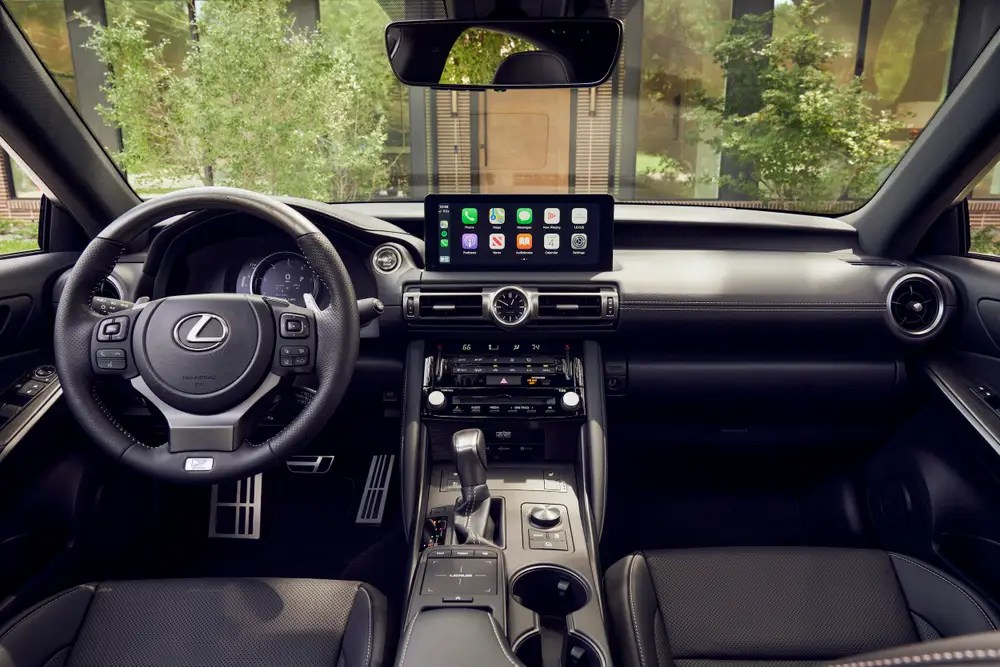
    Brands including Lexus, Toyota, and Subaru invite owners to pay for the convenience of being able to lock or start their cars remotely through an app. In some BMWs, you can pay to unlock automatic high-beam headlights, which dim for oncoming traffic. In 2020, BMW floated the idea of pay-as-you-go heated seats and steering wheels. General Motors and Ford both offer subscription plans for their hands-free highway driving systems. 

    Some people may welcome the ability to only pay for the features they actually want, rather than a big bundle of add-ons. But car companies still haven’t figured out exactly what customers are willing to pay for — and what feels like a frustrating upcharge. 

    In 2019, BMW abandoned a plan to charge $80 per year for Apple CarPlay after widespread pushback. In December, Toyota said it would review a subscription plan that unintentionally paywalled use of the key fob for remote start.

    “I think we’re going to see some interesting ebbs and flows of what really sticks,” Kolodge told Insider.

    Automakers run the risk of making customers feel like they’re paying twice — once for a function to be built into a vehicle and again to activate it, Kolodge said. They may have more luck asking people to subscribe to brand-new services, rather than familiar features, she added. 

    Understandably, drivers aren’t nearly as excited about recurring fees as carmakers are. 

    An April study by Cox Automotive found that 75% of consumers are not willing to subscribe to most vehicle features. Drilling down deeper, 92% of respondents said heated and cooling seats should be included in a car’s up-front price, while 89% said the same for remote-start functions.

    There’s a bill working its way through New Jersey’s legislature that would ban carmakers from charging on a subscription basis for features that use hardware already built into a vehicle and don’t cost the company anything to provide over time. Hackers have helped car owners upgrade their vehicles for years, and subscription features could be their next target, Vice reported

    Still, automakers see dollar signs. Stellantis (formerly Fiat Chrysler), Ford, and GM each aim to generate at least $20 billion in annual revenue from software services by 2030.  

    Over-the-air capabilities open up huge opportunities for carmakers to introduce new subscription or pay-per-use features over time, Wakefield, of AlixPartners, said. Someday, you may be able to fork over extra to make your car more efficient, sportier, or — in an electric vehicle — unlock extra range for road trips.

  • Why Used Tesla Prices Are Tanking

    Why Used Tesla Prices Are Tanking

    And why used electric cars could get a lot cheaper in 2026.

    [Published in InsideEVs Oct. 28, 2024]

    You may have seen the headlines in this publication and elsewhere: Used electric-vehicle prices are tanking. Perhaps you’ve even noticed firsthand that, in stark contrast to a year or two ago, used Teslas and the like are selling for huge discounts off of their initial MSRPs. 

    We’re talking about 25% price drops year-over-year in some cases. And what this all means depends on one’s place in the market. Massive depreciation is a gift to an EV’s second or third owner and a migraine for its first.

    Regardless, we wanted to understand the root of the issue and where prices could go from here. 

    The situation is far more complicated than “people just don’t want EVs,” which is the faulty premise underlying some coverage. And while depreciation is leveling off, there’s one big reason that it could get a lot worse down the line. 

    “We’re not setting ourselves up to counter the drop in EV used car values,” Karl Brauer, executive analyst at the car-buying website iSeeCars, told InsideEVs. “We’re setting ourselves up to exacerbate it.”

    What’s Happening?

    Vehicle depreciation is nothing new or unexpected. And for a while, it’s been clear that EVs hold their value worse than other cars do. But used EVs have been shedding value at an eye-popping rate recently.

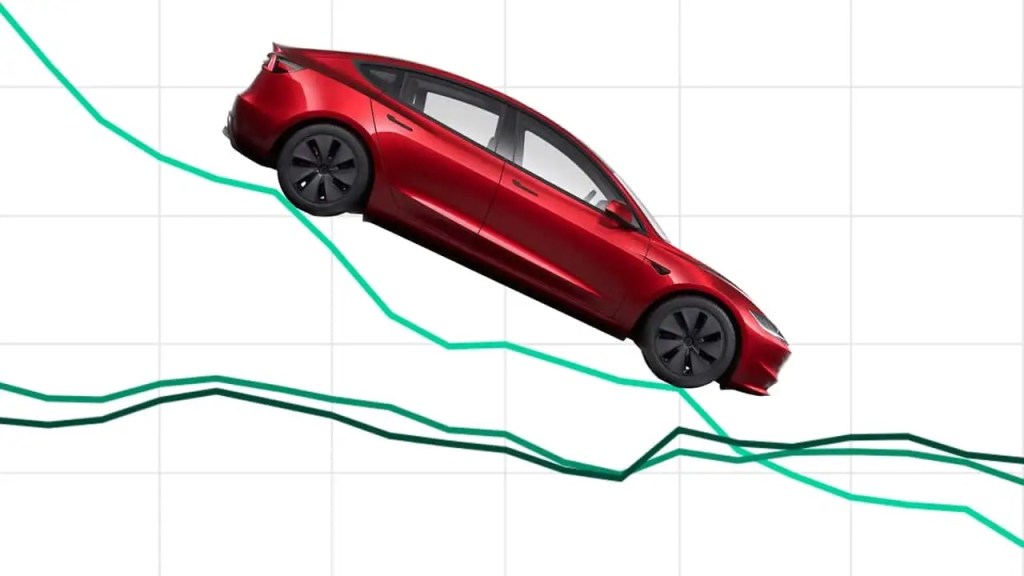
    In January 2023, the average 1-to-5-year-old EV was listed for roughly $48,500, a $16,000 premium over similarly aged gas vehicles, according to iSeeCars. That dynamic flipped as used EV values went into freefall throughout 2023 and 2024. Since the start of last year, used EV prices have slumped by 43%, per iSeeCars. By comparison, values for gas cars have decreased by only 4.5%. Both had been propped up by a pandemic-era supply crunch.  

    In September, the average 1-to-5-year-old EV was listed for $27,886, roughly $3,000 less than a gas counterpart. Tesla’s Model 3 sedan has been one of the worst performers. A September iSeeCars study found that prices had dropped by 25% year-over-year, the most of any model. 

    Black Book, which helps dealers value inventory, projects that three-year depreciation for new EVs will average around 60% by November. That’s significantly higher than the industry average of 42%. However, some in-demand EV models hold value better than others. 

    The Tesla Factor

    Experts say Tesla is largely responsible for the sinking values.

    “The biggest single factor can be summed up in two words, and that’s Elon Musk,” Brauer said. 

    After charging more and more during the high-demand pandemic years, Tesla slashed its vehicle prices throughout 2023. As the early-adopter appetite for EVs faded, competitors closed in and interest rates rose, Tesla had to act to keep inventory from piling up. And act it did. In 2023, Musk cut prices by around 25% across the board—ranging from 17% for the entry-level Model 3 to 35% for the high-performance Model X Plaid, according to Recurrent, a research firm that tracks the used EV market.

    At its peak in 2022, Tesla’s popular Model Y cost around $67,000 for the Long Range AWD variant. Today, that exact crossover costs $48,000

    Virtually overnight, all Teslas were worth less. That not only left customers royally pissed off, but it also had profound ripple effects across the entire EV market. Since Teslas account for about half of America’s EV sales, the price cuts also depressed what dealers could charge for battery-powered Fords, Kias and Toyotas.

    In part, the demand crisis was Tesla’s own fault. It failed to revamp its lineup at the same rhythm that competitors do, which forced it to stoke sales with price cuts, said John Helveston, a professor at George Washington University who studies the EV market. 

    “This is pretty common knowledge in automotive,” Helveston said. “You have to constantly release new models. If you don’t, your biggest competitor becomes the used version of your own car.”

    It’s Not Just Tesla

    Tesla isn’t the only culprit. EV growth has slowed amid economic uncertainty and high borrowing rates. In other words, people are still buying them, but just not at the accelerated rates the industry once projected. Now, however, used EVs are selling faster than used gas vehicles, which suggests to Brauer that the lower prices have brought demand more in line with supply. 

    The $7,500 federal EV tax credit and generous manufacturer incentives also play a role, experts said. EV depreciation doesn’t look so ugly when you remember that many buyers wind up paying far below sticker price. 

    “The subsidy effect here is very real,” Helveston said. “There’s still a gap, but it’s not as extreme as it looks on paper.”

    Moreover, the introduction of a used EV tax credit in 2023 accelerated the drop in values toward that program’s price cap of $25,000, Recurrent says. 

    Finally, used EVs straddle two vastly different car-buying groups, Brauer said. Wealthier EV enthusiasts would rather buy new or lease to access the latest technology in a fast-moving market. Used car buyers, meanwhile, focus on price and practicality. They’re less likely to have home charging or the same eagerness to take a chance on a new technology. “Philosophically, they’re more no-B.S.,” Brauer said.

    Where’s The Bottom?

    It’s the best time ever to snag a deal on a lightly used, long-range EV. For anybody who’s been banished to the sidelines of the EV transition by a lack of affordable options, that’s great news. But how low will prices go? 

    Liz Najman, director of market insights at Recurrent, says the pace of used-EV depreciation is beginning to slow. That tracks with iSeeCars’ observations too. Black Book projects that new EV depreciation will trend toward the industry average. 

    “If you’ve been holding off on buying an EV because you’re worried about price fluctuations, we feel like this is a great time to buy,” Najman said. She expects used EV prices to remain stable through 2026 or 2027. 

    The $25,000 price cap for the used-EV tax credit creates a natural floor for prices, she said. Plus, there aren’t many new electric models hitting the scene in the next few years. So the rapid pace of innovation, another contributor to bad resale value, is subsiding. 

    Around 2026, though, a flood of off-lease EVs will start hitting the used market. That could change everything. EVs are leased at a much higher rate than gas vehicles because any leased model qualifies for a $7,500 federal incentive, whereas only some buyers and models are eligible when a car is bought. 

    The deluge could depress prices further, Brauer said. But low prices may not be such a bad thing if the ultimate goal is to seed EV adoption.

    “An EV is something that’s still pretty new for most Americans,” Helveston said. “If they see a used one and it’s pretty darn cheap, that might start changing some minds.”

  • Why Are Tesla’s Automatic Wipers Such Garbage? InsideEVs Investigates.

    Why Are Tesla’s Automatic Wipers Such Garbage? InsideEVs Investigates.

    Tesla’s rain-sensing wipers haven’t worked right for years. Owners are fed up.

    [Published on InsideEVs Jan. 26, 2024]

    As Elon Musk’s Tesla forges ahead with moonshot projects like self-driving technology and artificially intelligent humanoid robots, its customers are stuck struggling with a much more mundane issue: Their windshield wipers suck. 

    “It’s the single worst thing about the car, honestly,” one Tesla Model 3 owner commented on one of the dozens of Reddit threads on the matter. Other internet users identifying as Tesla drivers have called their wipers “trash,” “absolutely infuriating” and “utterly useless.” 

    This isn’t a new problem, mind you: Tesla’s wipers have been broken for years, sparking a relentless chorus of complaints that the EV maker has never sufficiently addressed. It’s an embarrassing problem to have for a car company that claims to be so technologically far ahead of its peers. 

    So what’s going on here? Why can’t Tesla just send out a simple software fix like it so often does when things go wrong on its cars? InsideEVs decided to investigate. And we found that the problem hits at the very core of the way Tesla and Musk, its CEO, do business. 

    Tesla’s Auto wipers don’t work

    The issue at hand stems from Tesla’s “Auto” wiper function. The feature senses if and how hard it’s raining, setting the wiper speed to match the conditions. In theory. In reality, Tesla owners say that Auto mode routinely causes their wipers to swipe furiously when it’s sunny out, barely move in a downpour and everything in between. 

    As one owner put it on X, formerly Twitter: “No Tesla has auto wipers. We have an auto setting that activates super-random-wiper-fun-time-mode!” 

    Adding to owners’ frustrations, the wipers historically had to be set to Auto for Autopilot, Tesla’s fancy cruise-control feature, to function. It appears that Tesla quietly changed that in a recent software update and now allows drivers to manually switch off the Auto wipers when using Autopilot. But the function itself is still shoddy. 

    The thing is, rain-sensing wipers have been around for decades and work just fine for other manufacturers. Tesla’s problem appears to boil down to its particular, outside-the-box approach. It’s surely the only automaker that labels its rain-sensing wipers a “beta” feature, a term that usually refers to a tech product not yet ready for primetime. 

    What’s Going Wrong

    While cars typically use a dedicated sensor to register water droplets on their windshields, Teslas rely on a combination of built-in cameras and artificial intelligence instead. It’s all part of Musk’s quest to cut costs and replace all sorts of traditional automotive components—like radar units and ultrasonic sensors—with what’s called “Tesla Vision.” 

    This galaxy-brain solution to the simple problem of detecting rain is backfiring. 

    Chris Fox, a lead engineer at the engineering firm Munro & Associates, guesses it’s a calibration issue. Since Tesla’s cameras are first and foremost designed around its automated-driving efforts—to detect lane lines, other vehicles and so on—that could diminish their ability to reliably see other things, he told InsideEVs. 

    “It’s totally doable to detect the rain,” he said. “But also, depending on what else they’re doing with that camera, its depth of view, its field of view, it might not be able to pick up rain droplets.” 

    Fox estimates that a typical rain sensor alone would cost Tesla $10 on the high end, but it could be as little as under a dollar per vehicle.

    So that’s the hardware explanation, and it makes a lot of sense. There’s also the challenge of training an AI system to understand when it’s raining and when it isn’t, which Andrej Karpathy, Tesla’s former head of AI, spoke about at a tech conference way back in 2018. 

    “Tesla famously tries to save money all over the place. So instead of having a dedicated sensor for sensing whether or not it’s raining, Elon’s like ‘Well, you see rain drops, so vision can do it,’” he said. “And now, it’s my problem.”

    He said the AI model initially mistook all sorts of unexpected inputs for rain, like tunnels and smudges on the windshield. That sparked a painstaking labeling effort which saw Tesla feed the AI countless examples of what is and isn’t rain, he said. At the time, Karpathy said the Auto wiper system had recently gone live and “mostly works.” But Tesla continued working on it for years.

    In 2019, Musk tweeted that it “takes a surprising amount of deep learning to know when & how fast to move the wipers.” Four years later, in May of 2023, he apologized for the state of the Auto wipers and said the feature’s “neural net”—its machine learning system—would soon start using multiple cameras instead of just one. And still, owners say things like smudges and street lights confuse their wipers. 

    Perhaps wipers take a back seat to splashier AI projects like the Optimus worker robot and finally delivering a self-driving car, endeavors that Musk says could make Tesla worth trillions.

    Tesla’s Vision Problem

    For Sam Abuelsamid, an electric and autonomous vehicle expert at Guidehouse Insights, the wiper snafu is just further proof that Tesla’s vision system isn’t nearly as capable as the company says it is. Importantly, Tesla also relies on cameras and AI for Autopilot and Full Self-Driving, features with much higher stakes than automatic wipers. 

    Musk believes that if humans can drive with just eyes and a brain, then autonomous Teslas should be able to do so without industry-standard sensors like radars and lidar units. The firm doesn’t sell a self-driving car, despite hawking Full Self-Driving, a $12,000 prototype feature.

    “The reality is, as much as Elon Musk likes to gloat about it, Tesla’s machine vision systems are not actually very good,” he said. “They will perceive things on the road that aren’t there. In this case it’s raindrops, but they might detect that there’s something on the road and slam on the brakes, even when there’s nothing there.”

    Finally, this situation showcases a drawback to the auto industry’s wider push toward tech-heavy cars that can receive remote software updates. What’s great is your Tesla can download impressive new capabilities—like a horn that sounds like a fart or even something more substantive—at the tap of a button. What’s not so great is that a company can promise exciting features or bug fixes and keep kicking the can down the road. 

    That’s how you end up buying a $60,000 car with windshield wipers that never seem to work quite right. 

    We reached out to Tesla to learn more about what’s going on here but didn’t hear back. So it looks like you Tesla owners will just have to keep tweeting at Elon Musk.


  • Why The Rivian R3 Sparks So Much Joy, According To Car Designers

    Why The Rivian R3 Sparks So Much Joy, According To Car Designers

    Car design experts explain why the charming R3 hatchback stole the show at Rivian’s R2 reveal event.

    [Published on InsideEVs March 21, 2024]

    Earlier this month, EV upstart Rivian unveiled the R2, a smaller, more affordable, more mainstream SUV widely regarded as the young company’s ticket to the promised land of financial health. The rules of the car business dictate that if Rivian can sell more vehicles to more people, it can achieve the economies of scale necessary for it to stop losing billions of dollars—and maybe actually make a buck or two for investors. 

    Consequently, the new R2 is critical to Rivian’s future. Its success or failure will determine whether the promising and beloved startup triumphantly ascends to the ranks of Tesla and China’s BYD—or lands on the trash heap of failed automotive ventures.

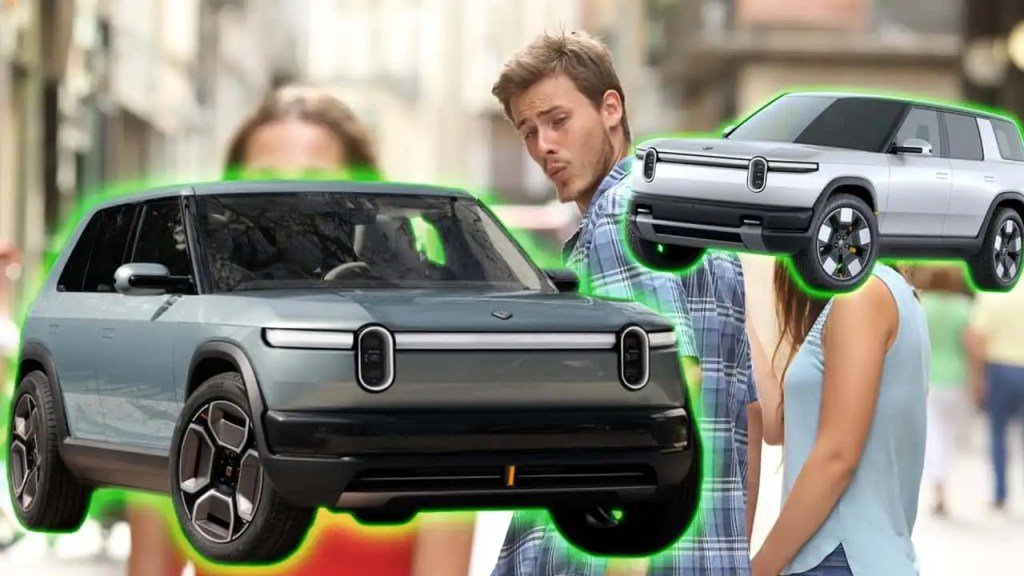
    But it was a different Rivian altogether that stole the show at the company’s R2 reveal event in California: the R3. “I’m really, really excited to talk about R2’s sibling,” Rivian CEO and founder RJ Scaringe said to audible gasps from the crowd. He then unveiled a pint-sized, angular hatchback that he said would cost even less than the R2. 

    Despite the lack of concrete details about price, range or release date, what followed was a drool-fest of epic proportions over the endearing little EV. Car nerds gushed about the R3’s resemblance to automotive icons. Even some regular people hopped on the hype train. I can’t recall such an overwhelmingly positive response to a new EV in recent years. 

    Sure, the apocalyptic Cybertruck caused a frenzy upon its unveiling in 2019, but that was mostly for the wrong reasons. Tesla’s pickup triggered a collective “They’re making that?” The R3 invited a chorus of “Please take my money!”

    But what exactly about the R3 struck such a chord with people? To find out, we asked a couple of car design experts for their professional opinions on why the R3 looks so darn good. 

    A lot of it has to do with nostalgia, they reckon. Across social media, the R3 immediately elicited comparisons to the first-generation Volkswagen Golf hatchback, sold in the U.S. from the mid-1970s to the mid-1980s (as the Rabbit). Both cars share the same generally boxy silhouette, sharp angles and crisp edges.

    “It’s really an iconic shape,” said Paul Snyder, chair of the transportation design department at Detroit’s College for Creative Studies. “And I think there’s an association made for, maybe, a happier past, subconsciously.”

    In a time of rampant nostalgia for 1980s cars, the R3 was bound to resonate with people, said Matteo Licata, a former car designer and design history professor at Italy’s IAAD (Istituto d’Arte Applicata e Design). “Launch it 10 years ago, and it wouldn’t have had the same effect, in my opinion,” he said. 

    Indeed, Rivian’s chief designer told The Drive that the R3 was inspired by 1980s rallying icons like the Lancia Delta Integrale and Audi Quattro. 

    What’s more, in an era when modern cars are overloaded with busy styling elements, the R3 is refreshingly simple and restrained, experts said. 

    “It’s not earth-shattering, but I think that’s the point,” said Snyder, whose design credits include the Honda Odyssey minivan and cult-favorite Ford Flex SUV. 

    Instead of grabby styling, the R3 relies on straightforward design and balanced proportions. The R3’s few “character lines” are all coherent with one another, and there’s nothing gratuitous or jarring going on, Licata said. The relationship between the height of the hatchback’s greenhouse and the sheetmetal below it resembles the cars of decades ago, before vehicles got so chunky, he said. Its stretched-out hood gives off Volkswagen Golf vibes, he added.

    It’s a breath of fresh air in other ways too, Licata and Snyder said. It tracks that a friendly looking, small, affordable hatchback would stand out in a car market dominated by large, expensive, macho SUVs. The R2 looks nice enough, but in broad strokes it’s more of the same. 

    On top of all that, the R3 benefits from just plain great design and execution. “They’ve done a brilliant job,” Licata said. “It is one of those rare designs in which I wouldn’t move a single line.” 

    Snyder said there’s a “rightness” about it and praised its proportions and thoughtful detailing. He’s also a fan of the R3’s big wheels and the deep beveling around its tail lights. 

    Charming as the R3 may be, Rivian has a mountain to climb before it can even hope to get the hatchback into eager customers’ driveways. First, it needs to manufacture and market the R2 without going bankrupt. If all goes well, by 2026 that cash cow should bring Rivian way more customers and revenue than the acclaimed but expensive R1T pickup and R1S SUV ever could. 

    Then there’s the challenge of actually selling the R3. Sure, U.S. consumers badly need more cheap, rationally sized electric vehicles to choose from. But there’s a big difference between generating a Tweetstorm and generating sales. 

    “Car enthusiasts are a very talkative, opinionated bunch,” Licata said. “But then they never buy anything.”

    06_Rivian_R3
  • Donald Trump’s Math On EV Chargers Is Way Off

    Donald Trump’s Math On EV Chargers Is Way Off

    Trump says the U.S. spent $9 billion on “eight chargers.” He’s not even close. A top EV charging official explains why.

    [Published in InsideEVs Aug. 9, 2024]

    Former President Donald Trump says a lot of things that aren’t true. One recent “alternative fact” related to electric vehicles was so off that we felt the need to correct the record. No, this isn’t about politics or the upcoming election; it’s just what we do. When people spew nonsense about EVs—or in this case, EV charging—InsideEVs claps back and brings receipts. 

    In at least three recent speeches—including his address at the Republican National Convention and at rallies in North Carolina and Atlanta—Trump said that President Joe Biden’s administration has spent $9 billion on “eight chargers.”

    It’s an eye-popping figure, for sure. And it’s also completely false. Even if you take that to mean eight charging stations rather than eight individual chargers, that’s a gross exaggeration.

    The math sure sounds absurd—about a billion dollars for one charger—but what normal person actually knows how much a charging station should cost? Why should they? In an election cycle that’s seen EVs get more politicized than ever, you, the people, deserve to know the facts.

    So let’s dive into what’s wrong here—and the tiny kernel of truth at the center of Trump’s outrageous claim. 

    How Many Federally Funded EV Chargers Have Been Built?

    What Trump is referring to, it would seem, is the National Electric Vehicle Infrastructure (NEVI) program, which was established by the 2021 Bipartisan Infrastructure Law. The program set aside $5 billion in federal funds to blanket the country—particularly its major highways—with thousands of new DC fast-charging stations.

    NEVI and the related $2.5 billion Charging and Fueling Infrastructure Grant program are important because a lack of dependable charging stations is one of the biggest concerns among would-be EV buyers.

    It’ll come in handy to understand the very basics of how the NEVI program works. States apply for federal funding, then put out requests for proposals for the projects they want done. Charging companies like Tesla and BP bid on the projects and handle construction and operation.

    NEVI runs through 2026, with a chunk of the total funds going out to states each year until then. So far, all 50 states plus Washington, D.C. and Puerto Rico have received a total of roughly $2.4 billion, according to the U.S. Joint Office of Energy and Transportation, which supports NEVI and other clean transportation initiatives. 

    It’s true that almost three years after NEVI was passed, only a handful of locations have come online. But it isn’t “eight chargers.” So far, 15 NEVI-funded charging stations have opened for business, providing 61 individual EV chargers to drivers across eight states, a spokesperson for the Joint Office said. The first station opened in Ohio in December, followed by sites in New York, Rhode Island, Pennsylvania, Utah, Hawaii, Maine and Vermont. 

    That may sound slow, but Gabe Klein, the office’s executive director, told InsideEVs that the rollout is proceeding at about the rate he had expected. 

    “We live in this 24-hour news cycle with social media and we just think, ‘Hey, you pass a bill and then next year there are chargers.’ And that’s just not how it works if you’re talking about building out major infrastructure,” he said. “It’s actually going really well, and we’re about where we thought we’d be.”

    Erecting high-powered charging stations doesn’t happen overnight, and it’s more complicated than installing a slower plug in a garage or parking lot. It takes 18-24 months just to bring power to a DC fast charger from the point the utility is notified, Klein said. Plus, it takes time for states to design projects, solicit bids and get things moving, particularly when they’ve never had to build EV chargers before, he said. Those processes are getting more efficient as time goes on, Klein said.

    “If you’re used to building bridges and highways, and now you’re responsible for building out a charging network, there’s a learning curve,” he said.

    Klein said that NEVI charger deployments should take off in the coming months and years. He expects the number of plugs in the ground to climb to hundreds by the end of this year and thousands in 2025. Installations should peak around 2027 or 2028, he said. 

    Did 8 Chargers Really Cost $9 Billion?

    So “eight chargers” is bunk no matter how you slice it. But how much do these stations cost? Hint: It’s not $9 billion for eight chargers. 

    The first phase of the NEVI program intends to fill major gaps in the nation’s EV infrastructure by placing stations at 50-mile increments along key corridors. According to the Joint Office’s analysis, that will require 1,537 locations with 9,222 total plugs, assuming six plugs per station. The total cost for that, the office says, will be roughly $1.1 billion. 

    Factoring in equipment, installation, five years of maintenance and station-related costs, the Joint Office estimates the cost of each NEVI-funded port to be $149,667. The government covers 80% of that, so its share comes out to $119,733. Even if that’s on the low end, you’re looking at a government spend in the hundreds of thousands of dollars for each station—not hundreds of millions or billions.

    While we’re at it, it couldn’t hurt to quickly address some other parts of Trump’s recent Atlanta speech that dealt with EV charging. “There’s no way you can ever load them up,” he said, referring to charging EVs. “They call it ‘loading’ them. You can’t load ‘em. We’re going to have to spend $9 trillion.”

    First off, as one of “them,” I can safely say nobody calls charging “loading.”

    Second, the National Renewable Energy Laboratory estimates that the U.S. will need somewhere between $53 billion and $127 billion in public and private EV charging investments by 2030 to support the growing fleet of electric cars. That’s a lot, but it’s also not $9 trillion. Or $5 trillion, or $12 trillion, which are other numbers Trump has thrown around in this context. 

    Trump also explained to the Atlanta crowd that “a charger is a gas pump with electricity coming through it.” Actually, that’s not a bad way of describing it. I’ll give him that one.

  • Why Lucid’s CEO Thinks 180-Mile EVs Are ‘The Future’

    Why Lucid’s CEO Thinks 180-Mile EVs Are ‘The Future’

    It sounds weird coming from the CEO of a company that makes EVs with over 500 miles of range. But hear him out.

    [Published in InsideEVs, Feb. 11, 2025]

    Lucid Motors has made a name for itself by building some of the longest-range electric cars on the planet. The Air sedan hit the scene in 2021 with the unprecedented ability to travel a bladder-busting 520 miles on a full charge. Nobody else has touched that yet—not even Tesla. 

    But Peter Rawlinson, the California-based EV startup’s CEO and CTO, thinks the future of transportation hinges on EVs with less range—way less, in fact. In a recent interview with InsideEVs, he said Lucid would “quite possibly” make a car with 180 miles of range on its upcoming midsize platform, which will underpin a line of more affordable vehicles.

    “That’s the future, definitely,” he told InsideEVs. “I wouldn’t say that midsize would be limited to that, but I could see a variant of midsize that’s just got that 10 years from now.”

    That idea may sound ridiculous today, when “range anxiety” remains one of the biggest factors keeping people hooked on gasoline. Automakers have been pushing ranges higher and higher to capture buyers on the fence—and you’re considered an unserious player if you can’t offer at least 250 miles, and preferably over 300. EVs with under 200 miles of range feel like a relic of a bygone era, when models like the Nissan Leaf and BMW i3 were on the cutting edge. 

    But Rawlinson argues that someday soon many people, particularly city dwellers, will realize they can get by with a lot less.

    Once charging infrastructure is abundant and reliable enough, drivers will get used to juicing up whenever they’re parked, he said. And once you can plug in anywhere at any time, you don’t need hundreds of miles of extra range as a buffer. By 2030, Rawlinson believes buyers will accept a range of 200 miles for a family car. 

    To be sure, that wouldn’t be ideal for ultra-long road trips. But Rawlinson’s point is that most people don’t drive too far on a typical day. According to the Department of Transportation, Americans tend to drive just under 40 miles daily. 

    He understands this all sounds weird coming from him. “It may seem paradoxical that you hear me saying this, when I’m synonymous with ultra-long-range vehicles,” he tells me with a grin. “But I’m actually synonymous with big-picture thinking.”

    It was always the plan at Lucid, he says, to start with high-end, long-range cars, then apply that same technology to mass-market, lower-range EVs that actually turn a profit. The startup’s whole game plan is to make EVs so efficient that they beat rivals on battery costs, while offering equivalent range. Right now, it’s still in stage one of that plan; the Air and just-released Gravity SUV are on the market, and a roughly $50,000 crossover is on the way for 2026. 

    Importantly, wide acceptance of limited-range cars could do wonders EV costs, which remain stubbornly high largely because batteries are so expensive

    Rawlinson says a roughly 180-mile Lucid would only need a 30-kilowatt-hour pack, a fraction of what’s used in most EVs today. Meanwhile, costs for lithium-iron-phosphate (LFP) batteries, a cheaper battery chemistry, have already dropped to around $60 per kWh, he notes. 

    “Then we can make a battery pack for about $2,500, maybe $2,000—instead of $20,000 or $25,000 today,” Rawlinson told the crowd at the BloombergNEF Summit in San Francisco, where InsideEVs caught up with him. “And that is the driver for the mass adoption of the EV to save all mankind in the future.”

    This low-range future will necessitate more investment not just in DC fast-charging stations, but also in slower Level 2 plugs, which Rawlinson thinks have been overlooked. Level 2 AC plugs aren’t as sexy as the high-powered chargers that can fill up a car in 20 or 30 minutes. But they’re cheaper to install and work great for apartment complexes, sidewalks and offices—places where people leave their cars for extended periods. 

    “My view is there is a myopia, an over-focus, on DC fast charging,” Rawlinson said. “The narrative should be about AC charging, overnight charging.”

    Don’t expect Lucid to pivot away from the road-tripping monsters it’s known for, though. Rawlinson says there will always be people willing to pay for the convenience of rarely stopping to charge. 

    “That is a lifestyle thing,” he said. “That is buying the experience of not having to charge at all.”